TaoPage.org | Home > Tao-te ching
Tao-te ching is the book master of Lao-tzu's Taoism, meant to provide teachings on a way of life according to the Tao. Its name translates: The Classic about the Tao and its Characteristics/Manifestations.
History of the Book
It seems that the book originates in the 4th century BC, but recent discoveries showed that it is not earlier than the 4th or 3rd century. The oldest existing copy is from 206 or 195 BC.
Tao-te ching pages written in Chinese |
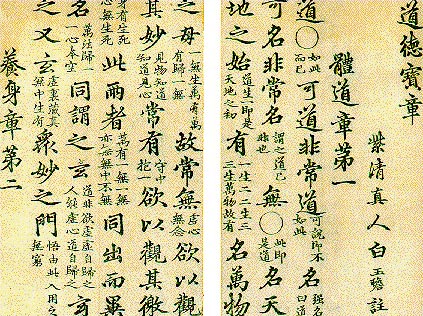
Lao-tzu would have composed this work at the request of Yin Hsi, the Guardian of the pass, while he began his wandering towards West. The guard would asked him to write a hand book of wisdom. This way Tao-te ching came into existence.
Summary
Tao-te ching consists in 81 short chapters among which 37 form the first part - the Classic of the Way (Tao) , and the next 44 form the Classic of Te. This division in chapters is considered to be the result of the remarks of mysterious Tao master Ho-shang kung (Han dynasty). The book's concern is the Way or Tao, and the emulation of its manifestation in our day-to-day life. Part of the chapters describe these characteristics, parts are
intended to teach us the Way, meaning the optimal behavior one should adopt in order to achieve something, avoid failure and even preserve one's life. Another part of the book is somehow a handbook of rulership for the use of princes and noble men involved in the public life.
Wisdom
The first chapter of Tao-te ching speaks about what is Tao, the key concept of Taoism. Thus, it reads: the Tao we know it is not the absolute one.
 |
The Tao may be known only if one gets rid of his many desires. In fact, one can not know the Tao directly but through its doings.
The wisdom of the book focuses further on concepts like Te, wu (emptiness), wu-wei (nondoing) and fu (return).
All are features of Tao (Way).
The disciple of Lao-tzu is taught to practice wu and nondoing as a modus vivendi, finally reaching the emotional detachment and feeling of ease and stillness like he/she would fly.
Mystery
The book is not limited to the wisdom and the art of leadership according to the Way. It also contains allusions to the practice of a kind of meditation
which could bring the practitioner the spiritual regeneration and even control over negative influences, from political to mystical and demonic.
Tao-te ching in the West
There are many translations versions of Tao-te ching in English as the book has many disciples even in the West, challenging the
Western culture and effort to understand the meaning of life and find a way out of turmoil and depression of these days. One of the most important translation is James Legge's because its author developed an empathy with the spirit of the book and revealed many of its secrets.
Foreword to Tao-te ching
Just because the book is very difficult to understand in our own terms of people living in the modern Western world, one should learn how to approach this book. In this respect we wrote a short essay named "foreword".
Read also:
- Tao-te ching Commented Chapters
What is Tao
Who Is Lao-tzu
Tao-te ching
Commented Chapters
- Definition of Tao (
chapter 1)- Waiting for the Right Time (chapter 2)
- About Abstinence from Action (chapter 3)
- Tao as a Bottomless Pit (chapter 4)
- Chapter 5
- About Long-enduring (chapter 7)
- Chapter 8 (The Virtue of Water Resembles the Tao)
- The Way of Heaven (chapter 9)
- Chapter 11
- They Make Mad the Mind (
chapter 12)- Chapter 14
- About the State of Stillness (chapter 16)
- About the Ancient Rulership (chapter 17)
- Tao and the Confucian Ethics (chapter 18)
- Features of Masters (
chapter 20)- The Partial and the Complete (chapter 22)
- Avoiding Excess (chapter 24)
- Heaven's Law vs. Man's Law (chapter 25)
- The Sage Follows the Tao... (chapter 26)
- About the Two Parts of a Whole (chapter 27)
- Keeping the Opposites as One (chapter 28)
- Avoid Excessive Effort (chapter 29)
- Avoid Force (
chapter 30)- He who Knows Others... (chapter 33)
- Chapter 35.
- Hiding the Light of the Procedure (chapter 36)
- Everything Happens by Itself (chapter 37)
- Chapter 39
- Chapter
40- Chapter 41
- About the Advantage of Practicing Nondoing (chapter 43)
- (Chapter 44)
- Knowing without Knowing (chapter 47)
- Chapter 48
- About the Mysterious Agreement (chapter 56)
- Parable of the Small Fish (chapters 60 and 60b)
(More commented chapters will follow soon, please bookmark this page or send us your email address to support@taopage.org to be included in our newsletter)
 |
Tao Te Ching translations
What is the best Tao-te ching translation? There is no such thing. The best translation has not yet been written. For many reasons...
And yet we prefer James Legge's.
Below are some translations that may be worth reading.
D.C. Lau Tao Te Ching
Traditionally attributed to Lao Tzu, an older contemporary of Confucius (551 - 479 BC), it is now thought that the work was compiled in about the fourth century BC. An anthology of wise sayings, it offers a model by which the individual can live rather than explaining the human place in the universe. The moral code it encourages is based on modesty and self-restraint, and the rewards reaped for such a life are harmony and flow of life.
Buy from Amazon.com
Tao Te Ching, translated by James Legge with commentaries
The wisdom of being a part of the Tao leads to a serenity of spirit that improves all aspects of human life, from the demands of work and family, to the dealing with life's joys and difficulties.
An essential for the meditation of Taoists for thousands of years, the "Tao Te Ching" is as beneficial and informative as it is enduring. This edition is translated with commentary by James Legge and is printed on premium acid-free paper.
Buy from Amazon.com
Tao Te Ching The Book of Meaning and Life, translator Richard Wilhelm
No other work of Chinese literature has attracted as much attention as Lao Tzu's "Tao Te Ching". It has been translated more often than any other book except the Bible and more commentaries have been written on it than any other Chinese classic. Both philosophical speculation and mystical reflection, the "Tao Te Ching" is about the harmony and flow of life and the
necessity for affinity to it.
Buy this book from Amazon.com
_______________________
©TaoPage.org, 2026.
