Taoism Beliefs Chinese Taoism is known to the Western world in two hypostases: philosophical and religious. The general impression is that these two branches are not separate, but complement and influence each other. Here are some of the ideas that both embrace:
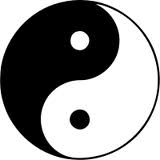
Tao - is the key concept of Taoism, itself an entity impossible to define in clear, unequivocal terms. "With name - says Lao-tzu - it is the mother of all things". Yin-Yang - the pair of opposites that rule everything that exists in the universe. Read more...Nonaction (wu-wei) - is the main characteristic of the Taoist
disciple's conduct. It consists in doing nothing effortlessly, in following the line of minimal resistance. Read more...Origin of the World - the world as we know emerged from a primordial chaos state passing through four stages: "The Tao produced One; One produced Two; Two produced Three;
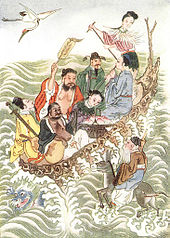
Three produced All things." (Tao-te ching, ch. 42) The Saint - or the "pure man" that realized the union with Tao, applying in his daily life its properties: wu (emptiness) and wu-wei (nondoing). Immortality - the search for immortality is one of the purposes of religious Taoism. In this respect, the eight
| The yin-yang diagram or T'ai chi t'u - The great ultimate - is the symbol of the origin of universe |
immortals (Hsien) are worshiped by Chinese.Life Preservation - in religious Taoism is achieved through alchemy recipes, the ingestion of various substances that confer long life or immortality, special diets or breathing and sexual exercises. Chi (Qi) - vital energy, like Hindu prana, that nourishes and sustains all living creatures and their living rhytms.
Afterlife - for Taoist philosophy, life and death are two sides of the same reality of Tao. More about Taoist view on death can be found in our article dedicated to this topic. -> Read about Taoism and Death.Magic and talismans - has played a crucial role in all forms of
Taoism because it was heavily used in medicine but also in exorcist rituals.
Leadership - in the Taoist vision, the political leader must conform to Tao. How will he do this? Through wu-wei, non-intentional intervention. The attitude of the political leader is distant and benevolent. He does not seek to shine, and as soon as he has accomplished what the times require, he retires modestly behind the scene.War - war is not encouraged by
Taoism. "When the Tao prevails in the world, they send back their swift horses to (draw) the dung-carts.
When the Tao is disregarded in the world, the war-horses breed in the border lands." (Tao-te ching, translation James legge). Dragon - Smbolize the Great man or the Immortal. Confucius called Lao-tzu a dragon. Read also:
|